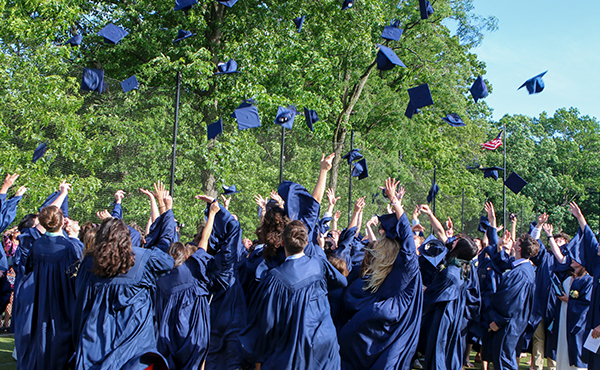
As graduation grows closer, the final months of high school are not only filled with celebration but also uncertainty. Seniors walk the school knowing their time is coming to an end, counting down to freedom while also carrying the weight of life changing decisions. Thoughts about prom and summer break mix with thoughts about majors, roommates and if they’re ready to be on their own. For many colleges is the next step, a place that represents independence, freedom and opportunity, but also uncertainty. Even in their excitement for freedom and individuality, many students are stressed about academic expectations, finances and being adults.
Senior Finn Shirmeyer is embracing this transition with optimism and enthusiasm as he is beginning this new chapter in his life.
“I am most excited to meet new people and continue playing soccer at the college level,” Shirmeyer said.
Senior Maya Loy is also quite excited about college life.
“I’m most excited about the college campus experience and getting to explore all the new things that we don’t see in a high school,” Loy said.
While both are excited for this opportunity, a sense of nervousness lingers.
“I am most nervous about figuring out what I want to do career wise and balancing academic and athletic responsibilities,” Shirmeyer said.
Loy’s nervousness stems from a new academic environment.
“I’m most nervous to meet my professors and have large classes. I think I’ll be fine because everybody is new to it,” Loy said.
For many seniors, the most intimidating part of the transition to college is the academic shift.
“For me, it’s gonna be the classes, just being able to get my work done and the rules are different. For example, they don’t have a 50 percent rule. That’s gonna be harder,” Loy said.
Shirmeyer shares similar feelings that social along with academic changes will be challenging.
“Classes and the social side of college stress me more than financial concerns,” Shirmeyer said.
As seniors transition into college, lots of their stress comes from academic and social pressures, while financial concerns often take a back seat.
“Financial concerns weigh on me somewhat, but strong financial aid and support from my parents help reduce that stress,” Shirmeyer said.
Loy shares a similar feeling on the weight of tuition and other expenses.
“I would say it weighs on me a little bit because it’s extra money that you have to come up with, but I think with support from my parents I should do okay,” Loy said.
Career and College Counseling Coordinator Deena Fogle is presented with these concerns on a yearly basis.
“I think paying for college is a huge one,” Fogle said.
Beyond the financial piece, senior stress also comes from uncertainty.
“Just the unknown, like, what’s it gonna be like in this new place? Am I going to find friends?” Fogle said.
Making new friends and finding a social circle is a common fear among seniors.
“Yes, I am worried about making friends, but I have a few friends that are going there, so the people they know, I’ll get to meet them, and then the people I know,” Loy said.
Being a part of a group or athletic team helps connect incoming students.
“ [Are you worried about making friends or fitting in?] A little, but being part of a sports team helps because it provides an immediate community of people with shared interests,” Shirmeyer said.
Being independent and living by oneself is a major shift from high school to college. Some seniors feel confident and prepared to take on this responsibility along with the challenges it entails
“I feel ready. I believe I am emotionally mature and capable of taking care of myself and managing daily responsibilities independently,” Shirmeyer said.
Some students already practice independence and responsibility.
“I already do a lot of stuff on my own. So I think living on my own is just gonna add another level,” Loy said.
Practicing independence in the household before students leave for college is highly encouraged. Fogle believes that senior year should be seen as a step toward adulthood.
“Try to encourage parents to see this as that transition year,” Fogle said.
She also stresses the importance of seniors taking charge in communicating with teachers and other adults.
Fogle expresses the importance of students being the one who have contact with the colleges, not parents. Many parents inquire about whether or not it should be them who reaches out, however Fogle explains how it is important that parents take the role of a cheerleader, only offering support while allowing their kids to practice advocating for themselves.
Senior year is a gradual transition from high school life to college life.
“Soft launch yourself as if you were a freshman so that when you get there, it feels comfortable,” Fogle said.
Leaving home is an emotional experience for most.
“I am excited to gain independence and start living my own life, but I know I will miss my parents and home,” Shirmeyer said.
College is a pathway into students’ future, pressure can stem from plans post college.
“I feel some pressure, but attending a liberal arts college gives me time and flexibility to explore different interests before choosing a major or career path,” Shirmeyer said.
Loy feels a similar pressure but has an idea on what she wants to do.
“I’ve already decided, so now it’s just if I really want to do that once I get to college,” Loy said.
Sharing a living space with another can be a major concern among many, as this can make or break a college experience.
“One fear I do not often share is ending up with a difficult roommate situation,” Shirmeyer said.
Loy shares the same fear.
“Finding a roommate, because you don’t want a room with a random person, because it could be really awkward,” Loy said.
As seniors prepare to enter college, an environment of freedom, responsibility and opportunity a piece of advice stands out.
“You are stronger than you think you are. You are ready for this,” Fogle said.