
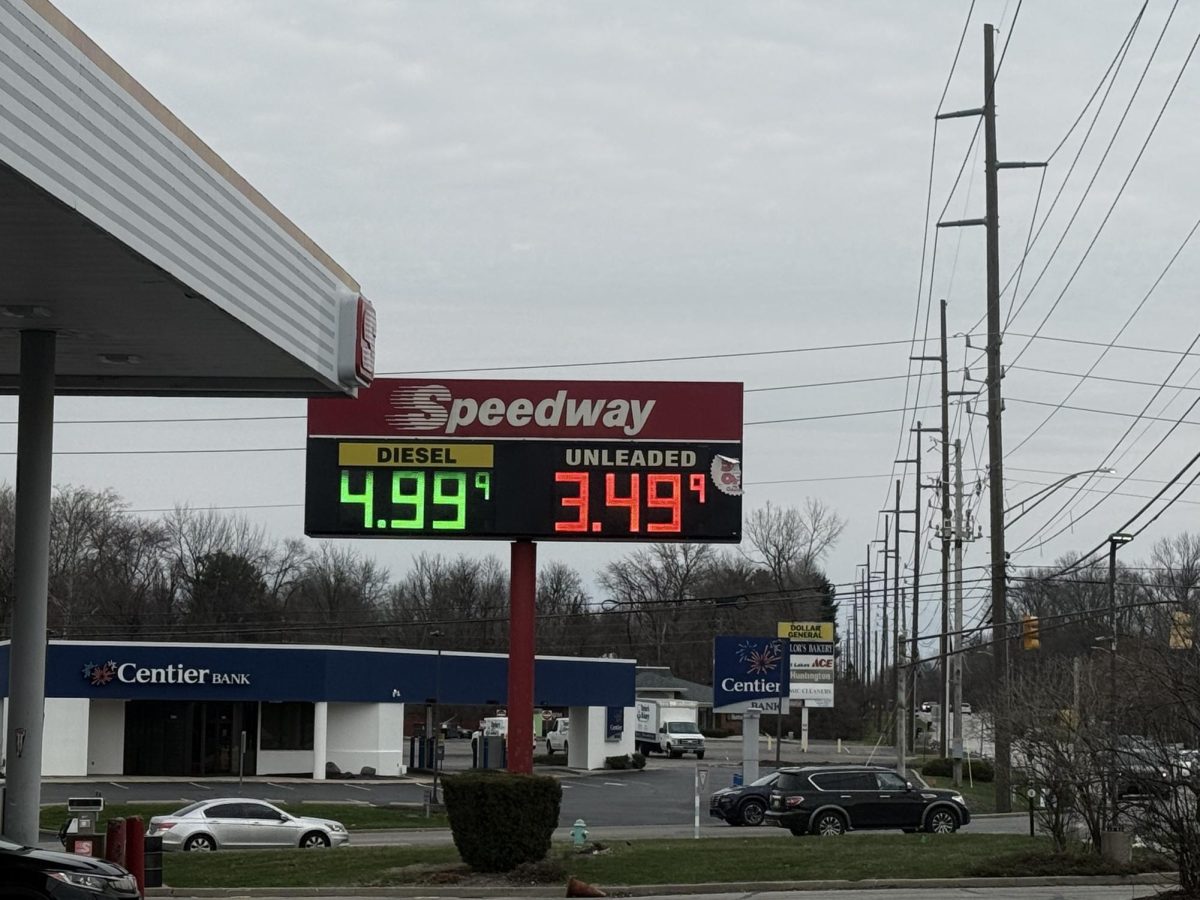
Gas prices have been fluctuating across the United States and have affected many drivers. This includes high school students and local businesses that rely on transportation. While the price of gas has not altered some students’ daily routines, others notice the rising prices and their apparent effects on their budgets. This has already started to influence how often they drive.
Student driver and junior, Jake Bolton, has noticed how much the price of gas has gone up since he got his license.
“When I first started driving it was probably like $3.25, now it’s around $4.70,” Bolton said.
Gas is a constant expense when owning a car. The type of vehicle you drive can affect how often you have to refill your tank, as different makes and models have varying gas mileage. Driving styles also affect gas mileage. Smooth, steady driving can extend the amount of miles you get per gallon while fast, aggressive driving causes fuel to be used up quicker.
“[Gas prices] change how much I drive and how fast I go,” Bolton said.
However, gas prices do not affect all students’ routines.
“It hasn’t changed my driving habits yet,” junior Pheonix Jones said.
Jones spends about $30 on gas biweekly and has not made any changes to her routine following the spike in gas prices.
The impacts on each student may vary. Students recognize that paying for gas affects how they spend their money.
“It may cut into the money I would rather spend elsewhere,” Jones said.
Students who finance their own gas can often feel the financial burden. Many adults might not recognize how much rising gas prices can affect students’ budgets.
“I think they affect students’ budgets a lot more because we’re broke and adults already have more money,” Bolton said.
The rise in the price of gas not only affects students on an individual level. Ryan Elfreich, a fleet manager of 126 vehicles for Midwest Remediation knows the cost of fuel too well.
“Our fleet spends around $56,000 a month on fuel,” Elfreich said.
Even small increases in price have a significantly larger impact when businesses operate a fleet of vehicles, companies that rely on transportation can see operating costs skyrocket.
“[Rising prices] will start to impact our net income,” Elfreich said.
Trying to manage these costs, businesses have to rely on tools to track fuel efficiency and usage. GPS systems allow companies to monitor vehicles and improve fuel efficiency.
“We have GPS monitors in all vehicles that assist us with tracking,” Elfreich said.
Other new tools such as artificial intelligence can also be used to increase fuel efficiency when traveling to job sites.
“With the assistance of AI software we are able to take the most efficient routes,” Elfreich said.
While students, drivers and local businesses feel the financial impact of fluctuating gas prices, economic factors play a major role in figuring out why gas prices fluctuate in the first place.
Economics teacher Andrew Wiggins explained the changes in fuel prices are usually related to the oil market.
“Gas prices almost always come down to supply,” Wiggins said. “What you’re seeing right now is the main artery through which huge amounts of oil for the world has been shut off.”
Disruptions in the oil industry can directly affect companies involved in the oil market as they face much higher risks.
“If you and I had a business that had anything to do with the production or distribution of oil, currently we wouldn’t be able to get insurance contracts to cover us and that makes our cost of doing business exponentially high or almost completely unaffordable,” Wiggins said.
Gas prices can vary based on location, geography and access to supply routes.
“If oil is coming in on the coast or if it’s coming through Texas, it’s easier for the states around there to get oil. It’s cheaper to get oil there,” Wiggins said.
Even within cities gas prices can fluctuate based on location and convenience.
“If you and I have a gas station and it’s right off the highway, and it’s convenient for people to stop there, then we can afford to charge higher prices than somebody that’s off the beaten track,” Wiggins said.
Rising fuel costs not only affect drivers, gasoline also plays a significant role in the transportation of goods.
“If we think about any part of that supply chain that is impacted by gasoline, the trucks that are moving something from one place to another, even milk. There’s no gasoline in milk. There’s no oil in milk, but because we’re using it to transport it, it ends up having an impact,” Wiggins said.
Transportation is incorporated into the infrastructure of American cities and is such an important part of everyday life. This makes it hard to have an individual impact on the price of gas.
“[Individuals reducing impact] It’s really difficult to do so. Of course the easy answer is to say carpool, don’t drive as much, but the way our society is built it’s hard for people to do that,” Wiggins said.
As gas prices continue to change, people may have to adapt and adjust their driving habits in order to keep up with rising fuel costs.
“Fuel is just a cost of moving people and getting work done. When prices go up, everyone feels it,” Elfreich said.