This semester North Central implemented a new detention system known as the Success Center. While detention centers tend to require students to just sit in a room, this room is formatted a little differently.
“Rather than having students be suspended in school without anything to do, this is a way where students reflect on everything that’s happened,” freshman dean Bryan Ramirez said. “That way they can return to classes with goals.”
When a student is sent to the Success Center they spend their time doing reflection activities and work on restoring any conflict that has happened.
“All students that are in the Success Center get interviewed,” Ramirez said. “It helps get to the root of why they’re there and what’s happened. We also see how they’re doing academically and behaviorally. We have that data and we’re able to track students and see how they’re doing.”
Having someone inside the room actively working with students was something principal Jagga Rent was intentional about.
“At my previous district, I walked into the school suspension room, and it looked like a jail cell,” Rent said. “There wasn’t even a person in there with the kids, just a secretary outside of the room who would peek in on the kids just to make sure they were alive. Students were just sitting in there, and we wondered why there was no change, why there was no success. And that is not what I wanted to be a part of.”
This sparked Rent’s curiosity in how to change the way schools have normally done detention.
“I just started to dream and think about an infrastructure that I thought could really catapult students to be successful,” Rent said. “The truth is that our students have a lot of different needs and so I wanted to create an environment where all students could succeed, no matter your interests, no matter your preference of learning, no matter your background. You gotta have a dynamic room, because we have dynamic students.”
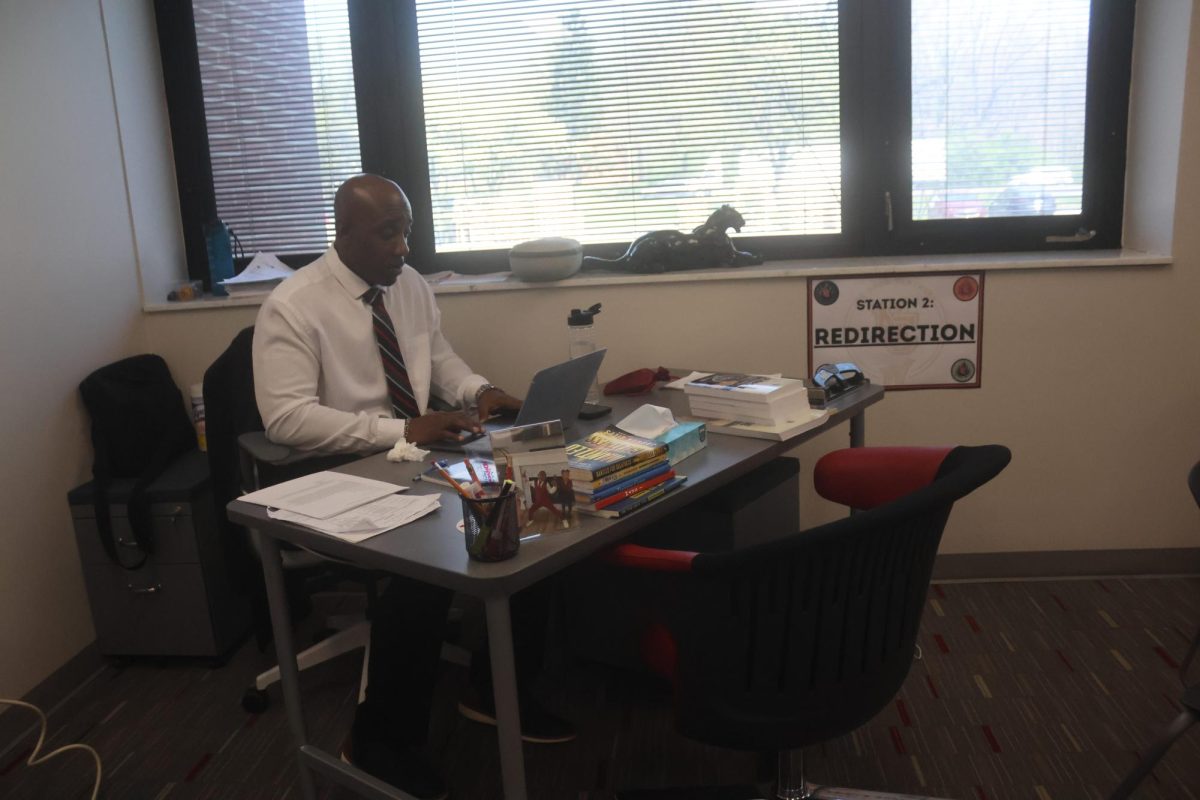
Sherman Flucas II is the staff member that works in the center with students.
“Some of the students have battles that they may be dealing with and a lot of our teachers may not have the capacity to deal with that,” Flucas said. “It’s exactly what I deal with. I help kids pull back the layers of the onion and help them start to identify some of those battles and actually help them heal.”
The center is based on three philosophies. The first is a cultural response to pedagogy.
“Culturally responsive pedagogy is, in essence, embracing students of differences,” Rent said. “It’s ‘hey, let me get to know you so I can know what makes you tick, what makes you respond and what makes you successful.’ It tries to create a program and a plan for that student based on their individuality.”
The second philosophy is trauma informed care.
“Many of our students who come to this room have an adverse childhood experience,” Rent said. “Something that has happened to them, in their background, that forms them for the rest of their life. There are 10 adverse childhood experiences that students typically grapple with for the rest of their life. Educators have to be informed on how to handle and regulate students who’ve been through those experiences because I can’t expect you to react to certain things a certain way if you’re dealing with that trauma.”
Trauma impacts the brain’s function.
“When you deal with trauma, you operate from your amygdala, which controls fight, flight and freeze, “ Rent said. “When you’re regulated, you operate from your prefrontal cortex, your executive function. You can think long term. Students can’t think about the long term if they’re deregulated and that happens because of trauma.”
A goal of the success center is to help students start to heal that trauma.
“I have the ability to be to go back and I can see for a student that between 4th and 5th grade, they start to get different grades.” Flucas said. “I can ask what happened. If there hasn’t been anyone who has tried to help them heal their wounds when they get to high school, it’s going to be very problematic. If you have an open hole in your soul and in your heart, it’s hard to fill it with academics and achievement. So that’s what the center is, coming to be a bridge over troubled waters for a lot of these kids.”
The third philosophy is restorative practice.
“The restorative practice component of this room is to make sure that students repair whatever they have broken by their behavior,” Rent said. “ What happens in a non-restorative space is if you break a rule, you get a consequence. But restorative means I’m gonna give you a consequence, but I’m also gonna give you an opportunity to fix whatever’s broken.”
These three philosophies help structure the six stations students go through during their time.
Station one is for reflection. Students take some time to think about why they’re there. Station two is for redirection
“That’s when you work directly with the facilitator, Mr. Flucas, to come up with a learning plan for the day,” Rent said. “Section three is the reconstruction station, where you’re executing the plan that you created with Mr. Flucas. Station four is the restorative practice piece. If a student has beef with a student, I might bring them here in the station to try to work on that. If a student has an issue with a teacher we’re gonna try to restore and repair that in this section.”
If students have earned it and done well with the first four stations, they go to station five for recreation.
“That station is where students get brain breaks,” Rent said. “When they’ve earned it they can play chess or checkers. We might let them just chill.”
The last stage, station six, is the reintegration stage.
“That’s another one on one protected time meeting with the facilitator to talk about what students have learned,” Rent said. “We have to make sure that students get something out of being here.”
In his time working with students, Flucas utilizes a virtual reality component to help gauge students’ emotional intelligence. Students do various activities using virtual reality and Flucas can better understand students based on their responses.
“Through that data data I can have very specific conversations with parents,” Flucas said. “I can now provide them with specific emotional intelligence evaluations that allow for them to have concrete conversations. It’s not generalized like saying a student is missing class because they’re sad or because they have things that are going outside. With this, I can actually be able to say the student has issues with self-awareness because they have things that are going on and I can deal with them more specifically.”
The Success Center has been open, using this system since January. Rent and Flucas shared a story about a junior they saw impacted by their work.
“We had a student in this building and Mr. Flucas looked at their trajectory of school. They were in 10th grade,” Rent said. “We have the ability to look at that student’s history of their grades, discipline, from their first grade and he saw that between fifth and sixth grade, there was a huge drop. They went from A and Bs to, D’s and F’s.”
Flucas shared his findings.
“I went all the way back in the student’s grades and saw it, and I asked him ‘hey, what happened to you during this time’ and then they communicated,” Flucas said. “come to find out, between fifth and sixth grade, that student ends up losing their mom, their dad, and their best friend, and no one knew. That child just kept coming to school every single day with a hole in their heart.”
Flucas was able to help the child not just with their behavior but with their trauma.
“When they told me, I was able to get them therapy,” Flucas said. “ I was able to get them hooked up with our counselor, get them involved with some of our layers of support that we have already in North Central. They’re now going to class, and now back on track to graduate.”
Looking forward, Rent and Flucas want to expand the work they’re doing.
“I want to create a virtual model where kids can actually be able to go in, to be able to see what a restorative conversation looks like instead of an unhealthy relationship,” Flucas said. “But simultaneously, I want to be able to create a reading, literacy, model and a virtual reality that actually deals with emotional intelligence development while increasing literacy.”
Rent shared his hopes.
“I would love to see this duplicated in other schools and across the country,” Rent said. “I’m crazy enough to think that this can work and that it will work and that we can scale out of this and not just the 3,600 students that come to North Central. But can we impact Indiana? Can we impact the United States? Can we impact the world?”